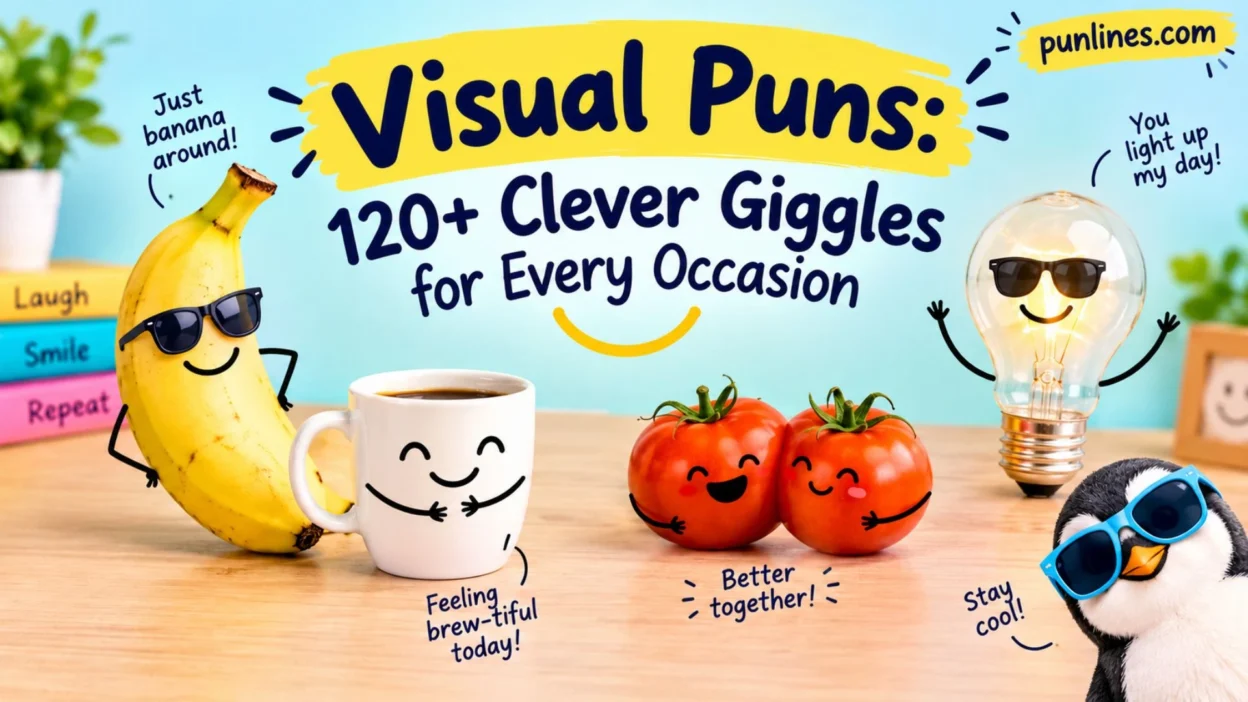
Have you ever seen a picture that made you groan, then smile, then want to show someone else? That, my friend, is the magic of visual puns—the art of making words and images collide in the happiest possible train wreck.
A visual pun doesn’t just tell you a joke. It shows you one. A fork in the road that’s literally a fork. It’s “time flies” with actual insects buzzing around a clock. It’s the kind of clever wordplay that works on your brain and your funny bone at the same time.
In this guide, we’re diving deep into the delightful universe of visual puns. You’ll get over a hundred clean, family-friendly examples, learn how to use them in captions and cards, and discover why your brain loves them so much. Whether you’re a pun beginner or a seasoned groan-master, there’s something here to make you chuckle.
Let’s get punny.
What Exactly Is a Visual Pun? (The 30-Second Answer)
A visual pun combines an image with a word or phrase to create double meaning. Think of it as a rebus with a sense of humor. The picture does half the talking, and your brain does the other half—usually followed by a sigh or a snort.
Researchers have found that visual puns actually help us remember things better. When your brain has to work a little to “get” the joke, the punchline sticks around longer. So the next time someone rolls their eyes at your pun, tell them you’re improving their memory. You’re welcome.
The Food & Drink Zone: Visual Puns That Belong on a Menu
Food is a goldmine for visual puns. Why? Because so many food words already sound like something else. Here are some of the tastiest examples.
- Hot dog: A picture of a dog sitting in the sun. Get it? Hot. Dog.
- Couch potato: A potato lounging on a sofa with a remote. Peak laziness, peak pun.
- Onion ring: An onion wearing a tiny ring, like it just got engaged.
- Cereal killer: A bowl of cornflakes holding a tiny spoon like a detective. Goofy, not scary.
- Mac and cheese: A computer (Mac) next to a block of cheddar. Tech meets dairy.
- Beer belly: A bottle of root beer with a round tummy. (Family-friendly version, of course.)
- Ice cream: A picture of a scream made of ice cubes. It sounds ridiculous. It looks hilarious.
- Pancake: A pan wearing a cape. Superhero breakfast, assemble.
- Watermelon: A melon made of water droplets. Hydration has never been cuter.
- Eggplant: A plant growing out of an eggshell. Botanical nonsense at its finest.
- Spaghetti: A yeti eating pasta. Wait—”spag-yeti.” There it is.
- Pumpkin pie: A pumpkin holding a pie chart. Math class just got seasonal.
LSI bonus: These funny food puns work beautifully as clever wordplay for restaurant menus, lunchbox notes, or Instagram captions. Pair them with a photo and watch the engagement roll in.
The Animal Kingdom: Wildly Funny Visual Puns
Animals are natural comedians. Add a camera and a clever caption, and you’ve got visual puns that practically write themselves.
- Catfish: A cat with a fish tail. Or a fish with cat ears. Either way, it’s weird and wonderful.
- Killer bee: A bee wearing tiny sunglasses and holding a sword. Too cool for the hive.
- Bullfrog: A bull sitting on a lily pad. He’s not angry. He’s just disappointed.
- Copycat: Two identical cats sitting side by side, one clearly mimicking the other. Classic.
- Bookworm: A worm wearing glasses, reading a novel. Intellectual invertebrate.
- Horsefly: A horse with wings. The original frequent flyer.
- Crab apple: A crab holding an apple. He seems confused about what to do with it.
- Batman: A man made of baseball bats. Or a bat wearing a tie. Both work.
- Panda-monium: A panda causing chaos in a china shop. The panda looks innocent. He is not.
- Snail mail: A snail delivering a letter. Slow but reliable.
Why these work: Animal visual puns are universally understood and almost always family-safe. They’re perfect for kids’ jokes, classroom posters, and greeting cards that need a guaranteed smile.
Everyday Objects: Visual Puns Hiding in Plain Sight
The best visual puns turn ordinary things into little jokes. Once you start looking, you’ll see them everywhere.
- Fork in the road: A literal fork stuck in a road. This one’s a classic from The Muppet Movie.
- Time flies: The words “TIME FLIES” written on a board with actual flies buzzing around them.
- Brainstorm: A brain wearing a raincoat, standing in a thunderstorm. Weather forecast: 100% chance of ideas.
- Couch potato: We mentioned this one, but it’s worth repeating. It’s that good.
- Soap opera: A bar of soap singing dramatically on a stage. High drama, clean finish.
- Key to happiness: A key shaped like a smile. Unlock the giggles.
- Mood swings: A playground swing with a happy face on one side and a grumpy face on the other.
- Emotional baggage: A suitcase covered in tears and smiley-face stickers. Relatable.
- Laughing gas: A gas pump with a giant grin. Fill ‘er up with joy.
- Home run: A house with running shoes. Real estate just got athletic.
- Negative space: A photo of outer space with a minus sign. Nerdy and perfect.
- Eye drops: Two eyeballs falling from the sky like raindrops. Slightly unsettling. Very funny.
Pro tip: These make fantastic visual puns for kids because the objects are familiar. A child who knows what a swing is will instantly “get” mood swings—and then explain it to you three times because they’re so proud.
Pop Culture & Movie Visual Puns: Giggles on the Big Screen
Filmmakers love a good visual gag. Some of the most famous visual puns in entertainment come from movies and TV.
In Spaceballs, Dark Helmet orders his troops to “comb the desert.” The next scene shows stormtroopers literally holding giant combs, dragging them through the sand. It’s absurd. It’s brilliant.
In The Muppet Movie, Kermit says they need to “turn at the fork in the road.” He lowers the map, and there’s a giant metal fork stuck in the middle of the highway. Simple, clean, unforgettable.
Animated shows and comics use visual puns constantly. The Far Side built an entire career on them. Even the Chinese Lunar Exploration Program got in on the act—their logo looks like the Chinese character for “moon” but also resembles two human feet, symbolizing “walking on the moon.” You can explore more about this fascinating mission on the official China National Space Administration site.
Caption gold: If you’re creating content, these pop culture references give you a built-in audience. Everyone loves a Muppets joke.
How to Create Your Own Visual Puns (Without Breaking a Sweat)
Making visual puns is easier than you think. Here’s a simple three-step formula:
Step 1: Pick a word or phrase with two meanings.
“Hot dog” works. “Fork in the road” works. “Bookworm” works. The best candidates have one meaning that’s literal and one that’s figurative.
Step 2: Draw or photograph the literal version.
If the phrase is “brainstorm,” show a brain in a storm. If it’s “couch potato,” show a potato on a couch. Don’t overthink it. Stick figures are fine. In fact, stick figures are often funnier.
Step 3: Add the words—or don’t.
Sometimes the image alone is enough. Other times, a short caption seals the deal. Experiment. See what makes you laugh.
Teachers use this exact method in language classrooms. They give students a phrase like “spring chicken” or “sleeping pill” and ask them to draw the literal interpretation. The results are usually hilarious and always memorable. If you want to dig deeper into the art of wordplay, Merriam-Webster’s dictionary is a wonderful family-safe resource for exploring double meanings.
Caption Gold: Using Visual Puns on Social Media and Beyond
Here’s where visual puns really shine: they’re shareable. A clever image with a punny caption is the kind of content people screenshot and send to their group chat.
- For Instagram bios:
- “Professional couch potato.”
- “Bookworm with a serious reading habit.”
- “Brainstorm chaser.”
2. For greeting cards:
- “You’re the sweet potato to my couch. Happy anniversary.”
- “I’d go to the fork in the road for you. And then I’d eat there.”
3. For classroom fun:
- Print visual puns and ask students to guess the phrase. It builds vocabulary and laughter at the same time.
4. For group chats:
- Drop a “time flies” image when someone says they’re bored. Instant chaos.
One golden rule: Match the pun to the audience. A “cereal killer” joke should stay goofy, never scary. A “couch potato” joke will make everyone smile. Know your crowd.
Why Your Brain Loves Visual Puns (A Tiny Science Break)
Your brain is lazy. In the best way possible.
When you see a normal picture, your brain processes it quickly and moves on. But when you see a visual pun, your brain hits a tiny speed bump. The image says one thing. The words say another. Your brain has to reconcile the mismatch. That moment of “wait, what?” is where the joy lives.
Research shows that this extra cognitive work actually improves memory. Visual puns facilitate recognition memory compared to non-punning images. In plain English: jokes stick.
So the next time someone groans at your pun, tell them you’re not just being annoying. You’re conducting a memory-enhancement exercise. Science says so.
The Dad Joke Zone: Visual Puns That Earn the Groan
You can’t have a visual puns collection without paying tribute to the groan-worthy greats. These are the jokes that make people laugh and sigh at the same time. It’s a package deal.
- A picture of a literal fork in the road. “Well, which way do we go?”
- A photo of a potato on a couch. “Living the dream.”
- A drawing of a brain in a rainstorm. “Hold on, I’m brainstorming.”
- A cat with a fish tail. “Catfish. You’re welcome.”
- A snail carrying a tiny mailbox. “Snail mail. It’s coming. Eventually.”
- A bee holding a sword. “Killer bee. Do not mess with the hive.”
- An onion with a wedding ring. “Onion ring. She said yes.”
- A worm with glasses. “Bookworm. Currently reading chapter three.”
- A house wearing sneakers. “Home run. Literally.”
- A soap on a stage. “Soap opera. Tonight’s episode: Rinse and Repeat.”
Dad joke protocol: Deliver these with a straight face. The pun does the work. Your job is to look proud of yourself, even as your family collectively groans.
Visual Puns for Every Season (Evergreen Fun with a Touch of Timely Cheer)
Most of these visual puns work year-round, but a few can be dusted off for special occasions.
Spring: “Spring chicken” (a chicken on a trampoline). “April showers” (a showerhead raining flowers).
Summer: “Hot dog” (a dog in sunglasses). “Ice cream” (a scream made of ice).
Fall: “Pumpkin pie” (a pumpkin holding a pie chart). “Leaf peeping” (a leaf with eyes peeking over a branch).
Winter: “Snowball” (a ball made of snow, obviously). “Mitten” (a mitten with a kitten inside).
The beauty of visual puns is that they’re 90% evergreen. You can share a “couch potato” joke in January or July. It works every time.
A Quick Checklist: Is Your Visual Pun Actually Good?
Not all visual puns are created equal. Before you unleash yours on the world, run it through this mental checklist:
- Is it understandable? If you have to explain it twice, it might be too obscure.
- Is it family-friendly? Keep it clean. The best puns work for all ages.
- Does the image do half the work? If the picture is just decoration, it’s not really a visual pun.
- Would you share it? If you’d screenshot it and send it to a friend, it’s ready.
- Does it make you smile? That’s the only test that truly matters.
Frequently Asked Questions About Visual Puns
What is a pun, exactly?
A pun is a play on words that uses double meaning or similar sounds to create humor. A visual pun adds an image to the mix, so the joke works on both your eyes and your brain. For a deeper dive into how puns are built, Britannica’s guide to figures of speech is a great family-safe reference.
Why do people love puns so much?
Puns are surprising. They set up one expectation and then deliver something else. That little twist releases tension and triggers laughter. Plus, puns are social—they’re meant to be shared. A pun shared is a pun doubled.
Are visual puns good for kids?
Absolutely. Visual puns build vocabulary, encourage creative thinking, and teach kids that language is a playground. They’re also a fantastic screen-free activity. Draw a “brainstorm” and see what your child comes up with. You might get a “brain-rainbow” or a “thought-thunder.” Let them run with it.
The Last Laugh: Go Forth and Pun
We’ve covered a lot of ground. Food puns. Animal puns. Dad jokes. Movie magic. The science of why your brain loves a good groan.
Here’s the thing about visual puns: they’re not just jokes. They’re little moments of connection. A punny card makes someone’s day. A clever caption gets a laugh from a stranger. A classroom pun helps a kid remember a new word.
So go ahead. Draw a potato on a couch. Photograph a fork in the road. Caption your cat as a “purr-fessional napper.” The world needs more reasons to smile, and you’ve got a toolbox full of them now.
Your turn: Which visual pun made you laugh the hardest? Drop it in the comments. Share this article with the pun-lover in your life. And remember: if someone groans at your joke, that’s just the sound of a pun working perfectly. Now go forth and be punny.
Read more related articles at punlines.com.

Noah Brooks is a humor writer at Punlines, specializing in witty puns, clever jokes, and smooth pickup lines that make every conversation more fun